Sunday, January 9, 2011

APOD 2.6


I am so glad to have stumbled upon this APOD. With the changing of seasons, summer to fall to winter, Alex and I observed with remorse as the Summer Triangle rose lower and lower in the sky. The Summer Triangle was the basis for everything. It was the compass to my rose and now I look at the night sky with confusion. "Oh, there's Orion." That's it. That's all I got. But wait! All hope is not lost! The Winter Hexagon exists. I once again have some sort of direction in my life. The six stars of the Winter Hexagon are Aldebaran, Capella, Castor Pollux, Procyon, Sirius, and Rigel. Armed with this knowledge I will be much more prepared to take on the Winter Sky!

The Night Sky 12/21/10

Well! Wasn't that fun! The lunar eclipse watch a Pine View was a grand success. My parents were pretty convinced that I was crazy to stay up until five, but hey, it's educational. Besides it's not like the moon is eclipsed every night. Speaking of the eclipse, I thought that it would be a brief moment's fun, but it wasn't. The gradual shadowing and reddening of the moon leading up to the peak was absolutely as good as the total eclipse! The night was very cold, I spent much of it under blankets and just looking at the stars. I braved removing myself from the blankets only twice, once to see a star cluster that I can no longer remember the name of (hence why we post as soon after observing as possible) and again to see Saturn's rings. Well worth the few minutes of freezing. The Pleaides continues to inspire, especially with binoculars and the Hyades is cool as well. Saw some constellations, Orion of course, Taurus, Canis Major, Pegasus, and Triangulum. Well, maybe I saw Triangulum, but it's very easy to pick any three stars and call it Triangulum. Life. Anyway, it was a good time for sure.

APOD 2.5


Okay, okay. You got me. This isn't actually an APOD post. It's an AVOD post. An Astronomy Video of the Day! Our friends at NASA rarely feature videos for their APOD so when they do, you know it's got to be good. Well, it is. The thirteen second video features a solar prominence which happened on December 6th and is really really cool. The prominence was almost a million km long. Astronomers note that this particular filament had been seen hovering above the Sun's surface for over a week before it exploded. A filament is a large region of dense, cool gas that is held in the chromosphere by magnetic fields. This image sequence was taken by the Solar Dynamics Observatory, an orbiter launched February last year to observe the sun for five years. The plasma cloud emitted by this coronal mass eruption missed the Earth and thus did not cause any auroras. But the sun is nearing Solar Maximum Activity so we'll being seeing more auroras and cool stuff like that soon enough.

APOD 2.4

See Explanation.  Clicking on the picture will download
 the highest resolution version available.


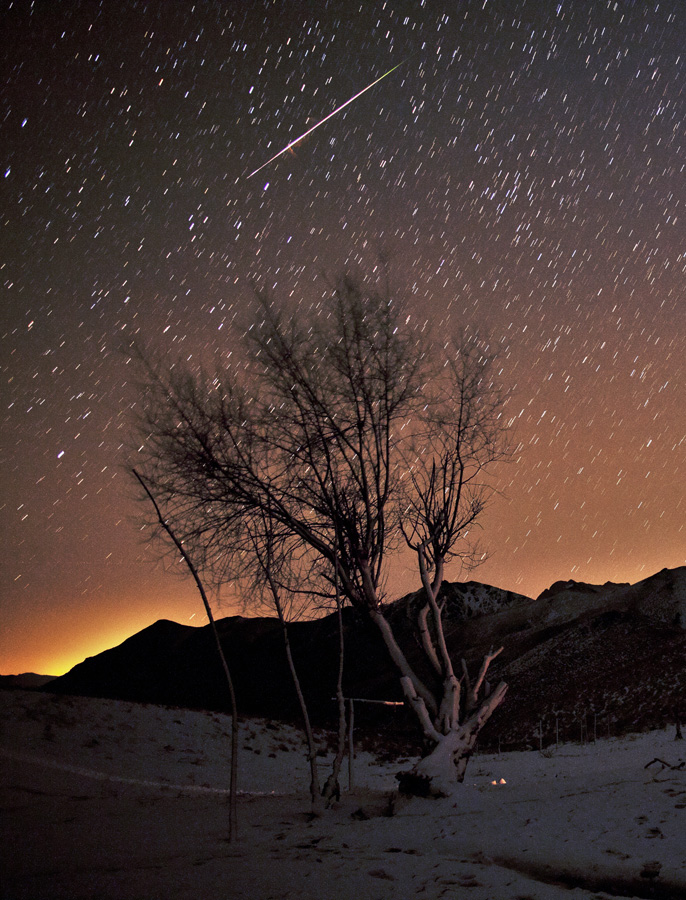
This is a photograph, exposed 1.5 minutes, taken in Iran in the Karkas mountains during the annual Geminid Meteor Shower. It makes me highly regret not waking up to see the meteor shower from my own home. The Geminids originate from a 3200 Phaethon, which is a large rocky object. This makes the Geminid meteors different from your average meteors as they originate from a comet. The arching trails of the meteroids reflect the Earth's rotation on its axis. This meteor changed color as it burned through the sky. You can see in the middle of the path a reddish glow that marks the change in hue.

Saturday, November 20, 2010

APOD 2.3

See Explanation.  Clicking on the picture will download
 the highest resolution version available.

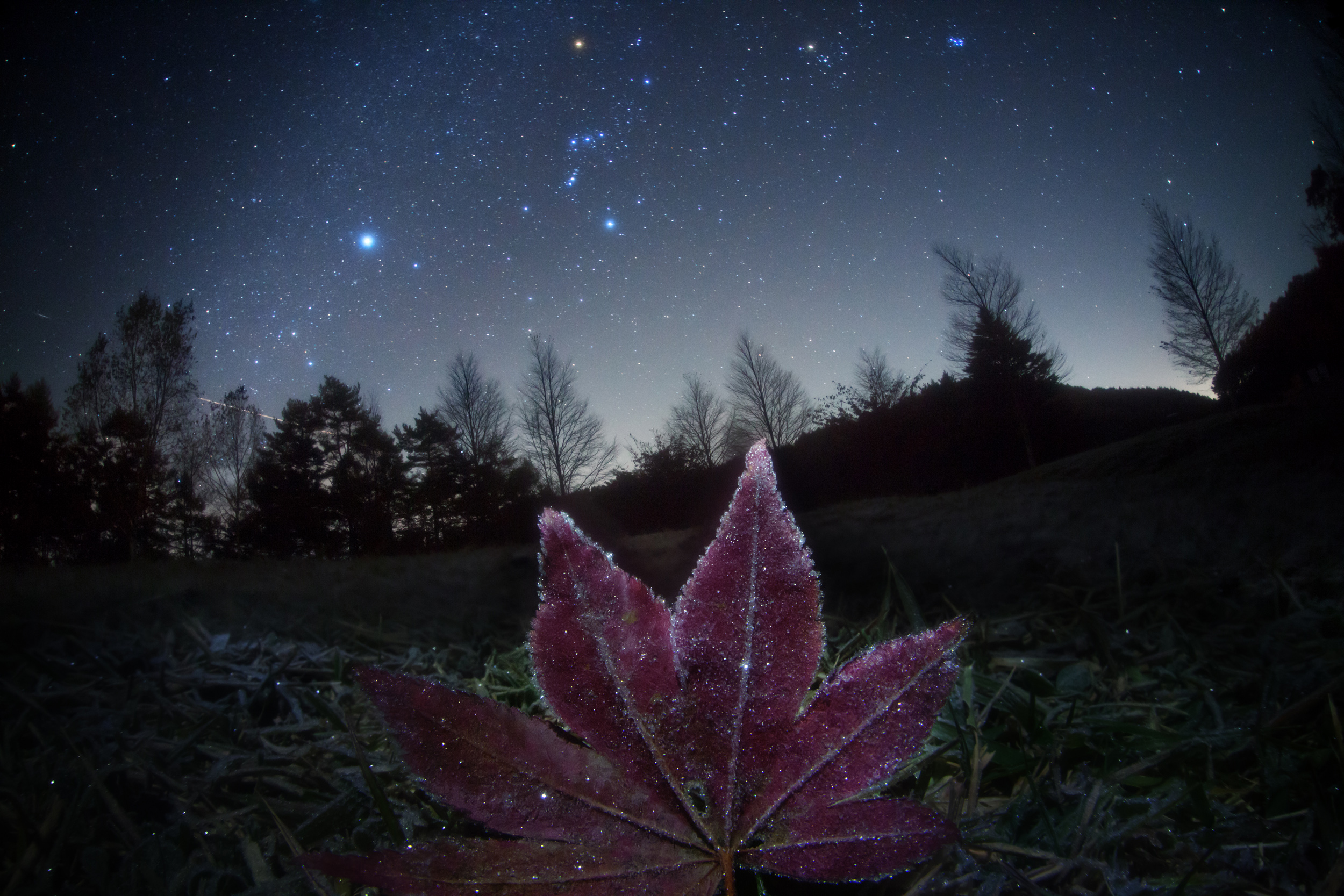
What a striking photograph! I love how the light reflected off of the ice crystals on the leaf mirrors the light of the stars in the background. Easily recognizable in that background are the three stars of Orion's belt, the red giant, Betelguese, the star cluster of Pleiades, and Sirius, the brightest star in the sky. This photograph was taken in Japan earlier this month, but one can see a similar view of the sky throughout the next couple of months in the northern hemisphere. Following the link on the apod page about Japan, I learned that Japan is an archipelago comprised of 6,852 islands! Among other very interesting historical tidbits about the island nation.  


Friday, November 12, 2010

The Night Sky 11/09/10

Where? Blackburn Point
When? 6:30-8:00

We had a truly splendid stargaze last night! The night was clear and despite a few rowdy parkgoers (who knew so many people launched kayaks at eight o clock?) we were able to see a great number of interesting sights. On the top of my list was the Pleiades, the Seven Sisters, Suburu, M45 etc. etc. open star cluster. Pleiades is the second cluster nearest to us behind the Hyades, which we also saw with the naked eye and then with binoculars. We took another look at the Andromeda galaxy, this time with our fancy telescope, who took it upon itself to tell us which direction it was pointing all night long. We saw M11, the Wild Duck Cluster, the open cluster found in Scutum. I was also a big fan of this one. We looked at the waxing crescent moon with our fancy telescope and it was soooo cooool. All sorts of craters and mountains were absolutely enthralling. I could look at the moon all day. Or all night... So anyway, we did the Great Worldwide Star Count and got a limiting magnitude of five for the constellation Cygnus. Very fun stuff.

Sunday, November 7, 2010

APOD 2.2

See Explanation.  Clicking on the picture will download
 the highest resolution version available.

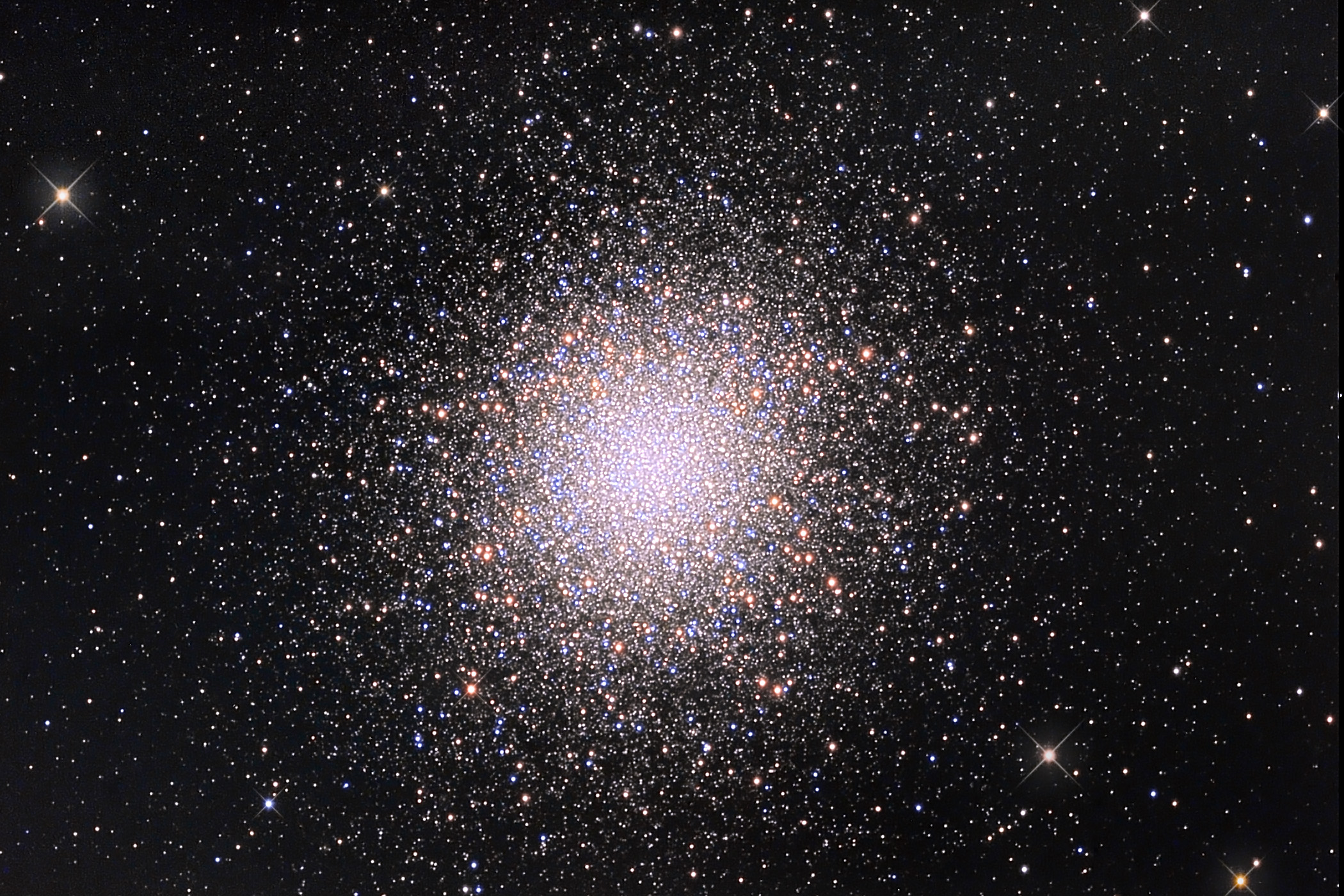
Week after week I've known that M13 goes in the miscellaneous category for the constellation Hercules on our COTW quizzes. Yet, I hadn't a clue what M13 really was or looked like. Here it is! The Great Globular Cluster of Hercules! Noted by English astronomer Edmund Halley, "This is but a little Patch, but it shews itself to the naked Eye, when the Sky is serene and the Moon absent." This cluster is composed of highly concentrated, oddly close together stars, hundreds of thousands of them, in a region just 150 light years in diameter. Stunning in its clarity, this image reveals the mystery behind Hercules' very own M13.